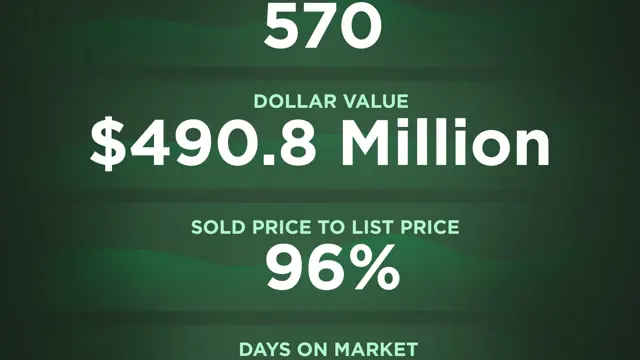
Teton Valley Real Estate: Strong Sales, Growing Inventory, and a Changing Market
I tend to get a theme stuck in my head, and that theme inevitably translates into conversations I have with real estate clients. Lately, that theme has been the growing inventory of homes for sale in Teton Valley, despite what still feels like a relatively strong sales market.
I seem to have more clients on the selling side than the buying side these days. Maybe that's a reflection of what's happening in the market, or maybe it's simply the result of how my business has evolved over the past 12 months. I've been fortunate to have a great year, but I can't help noticing listings lingering and inventory continuing to increase.
Without sitting down to study the numbers, and based largely on intuition alone (I do, after all, look at real estate data every day), I've been telling sellers that sales volume over the past 12 months has actually been quite strong compared with the preceding 12 months. What's changing, at least in my mind, is that inventory seems to be accumulating faster than sales can keep up.
Couple that with elevated interest rates, geopolitical uncertainty, and other pressures in our local marketplace, and we're beginning to see a compounded effect that builders and sellers are feeling.
Whether I've been defending my position as a broker who should be moving inventory, or simply recognizing the reality of changing market conditions, I figured it was time to look at the actual data and see whether the numbers support what I've been telling people.
First, Are Sales Really That Strong?
Looking at residential sales data dating back to January 2023, it appears that my internal data collector has been doing a reasonably good job.
Honing in on the exact language I've been using with clients, residential sales over the past 12 months have actually been stronger than during the preceding 12 months.
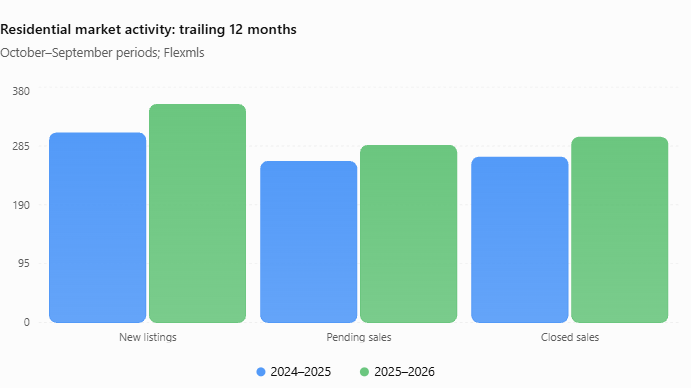
Between October 2025 and September 2026, Teton Valley recorded 299 residential sales totaling approximately $341.3 million. During the preceding 12 months, there were 267 transactions totaling approximately $282.3 million.
That's an increase of approximately 12% in transactions and nearly 21% in dollar volume. Even pending sales increased by 10% during the same period.
In other words, people are still buying real estate in Teton Valley. In fact, they're buying more than they were a year ago.
Of course, those figures don't mean individual property values are appreciating at the same rate. A handful of expensive transactions can have a disproportionate impact on dollar volume, and the mix of properties sold changes from year to year.
Nevertheless, the broader takeaway is that demand hasn't disappeared.
So, What's Changing? Inventory.
Here's the flip side of my theory, and arguably the more interesting part of the story.
If sales remain relatively strong, but inventory continues to increase, something else must be happening. More properties are entering the market than buyers are absorbing, creating additional competition among sellers.
Once again, the numbers generally support what I've been observing.
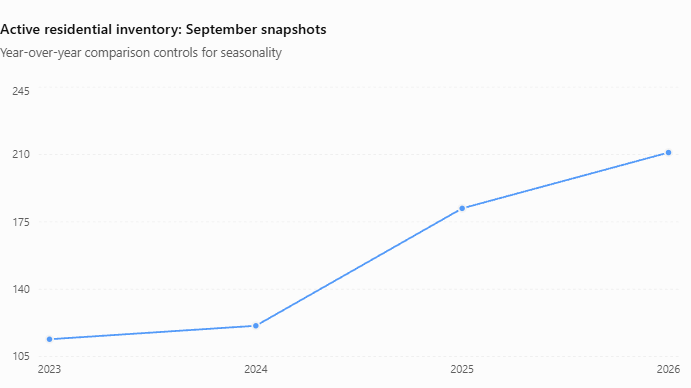
Active residential listings increased from 182 in September 2025 to 211 in September 2026, an increase of approximately 16%. Looking back another year, September 2024 had just 121 active listings.
That's a substantial increase in available inventory over a relatively short period.
There's an important seasonal component to consider. Inventory in Teton Valley typically builds during the spring and summer before declining through the fall and winter. We've seen that pattern consistently over the past several years.
What stands out this year is how little inventory has declined from its summer peak. Active listings reached 214 in both July and August before slipping to just 211 in September.
Meanwhile, 352 new residential listings entered the market over the past 12 months, compared with 306 during the preceding year. That's a 15% increase in new listings, outpacing the 12% increase in closed sales.
September was particularly interesting, with 32 new listings compared with just 15 during September 2025.
Granted, there's more to the inventory equation than new listings and closed sales. Expired and withdrawn listings, relistings, and changes in pending status all contribute to the final numbers. But the trend is difficult to ignore.
We're continuing to sell homes at a reasonably strong pace. We simply aren't absorbing all the additional inventory.
Absorption, Days on Market, and Pricing
Naturally, the next question is how all of this is affecting sellers.
Typically, increasing inventory creates more competition, longer marketing periods, slower absorption, and ultimately greater pressure on pricing.
We're beginning to see some of that, although the data isn't entirely consistent.
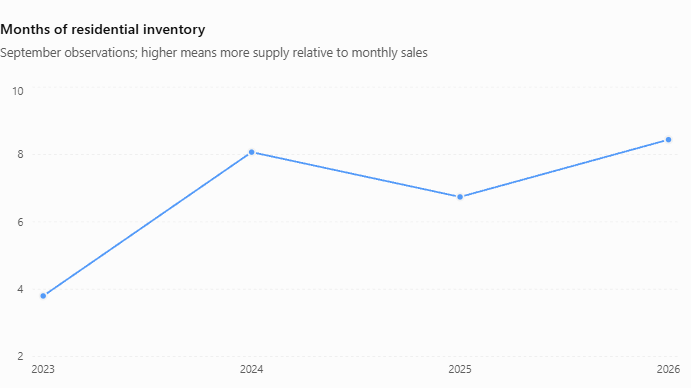
In September 2026, Teton Valley had approximately 8.4 months of residential inventory, compared with 6.7 months one year earlier. That suggests more supply relative to the current pace of sales, though monthly absorption figures can fluctuate significantly in a relatively small market.
Days on market tell a somewhat different story. The average home sold in September 2026 had spent 122 days on the market, compared with 129 days in September 2025. Rather than increasing, that figure has remained relatively flat.
I don't find that entirely surprising. The properties that sell aren't necessarily representative of the properties that remain on the market. Properly priced homes can continue to attract buyers even as overpriced or less desirable inventory accumulates.
Pricing is perhaps the most interesting piece of the puzzle.
The median asking price among active residential listings increased from approximately $849,000 in September 2025 to $1.25 million in September 2026. Meanwhile, the median closed sale price was approximately $945,000 in September 2026.
These aren't direct comparisons of identical properties, and an increasing number of higher-end homes in the available inventory could explain some of the difference. But they do illustrate the gap between what sellers are asking and where transactions are actually occurring.
Looking at negotiated prices, homes sold during September 2026 averaged approximately 96.8% of their final asking price and 93.6% of their original asking price.
Those discounts aren't necessarily increasing compared with last year, but they demonstrate that pricing adjustments and negotiations remain part of the market.
I think we're approaching an interesting point where the expectations of sellers, the realities of construction costs, and the buying power of purchasers are becoming increasingly difficult to reconcile.
Who Does This Affect the Most?
My suspicion is that builders, new construction, and relatively recent homeowners who find themselves needing to sell unexpectedly are among the most vulnerable to these changing conditions.
For builders, there's an unfortunate reality that extends well beyond the real estate market.
The cost of labor, materials, land, and financing remains stubbornly high. Tariffs have added pressure to certain building products, and the broader cost of living continues to affect what it takes to maintain a workforce and operate a construction business in Teton Valley.
At the same time, elevated mortgage rates have reduced purchasing power for financed buyers. Freddie Mac reported an average 30-year fixed mortgage rate of 7.40% in mid-October, compared with 6.27% a year earlier.
The result is an increasingly uncomfortable disconnect between what it costs to produce housing and what buyers are willing or able to pay.
It's easy to assume that increasing asking prices are simply the result of builders looking to capitalize on a profitable business model. And certainly, there's some of that. But I think it's important to recognize that construction costs have experienced very real increases, even as our local residential resale market has struggled to demonstrate consistent appreciation over the past several years.
I wrote about some of that in my Q1 2025 Residential Market Report & Lookback, where we looked at the market's transition following the rapid appreciation experienced during and immediately after COVID.
For many builders, this creates an especially difficult position. A completed home may cost substantially more to construct today than it would have a few years ago, but that doesn't necessarily mean the market will support a corresponding increase in its selling price.
And there's another component to the business model that consumers don't always recognize.
Builders often realize value through their own labor, established subcontractor relationships, material purchasing arrangements, and economies of scale. Those advantages can make it possible for a builder to produce a home for significantly less than an individual consumer might spend building a comparable custom home.
But those relationships need to be maintained.
One builder recently described his business to me as a train that needs to keep moving. Reduce the volume of projects, and subcontractors find work elsewhere. Established relationships become more difficult to maintain, purchasing advantages disappear, and restarting that momentum can be expensive.
I think that's a useful way of understanding why some builders continue bringing homes to market even when margins are increasingly thin.
It's not necessarily that they're overlooking changing market conditions. Sometimes the cost of slowing down can be nearly as consequential as the cost of continuing.
Recent homeowners facing an unexpected need to sell can find themselves in a similar position. Without meaningful appreciation, the transactional costs associated with buying and selling real estate can be difficult to recover. A market that has experienced relatively flat or inconsistent price growth since the rapid appreciation of 2021 and 2022 doesn't necessarily provide much cushion for someone who purchased recently.
So, Where Does That Leave Us?
I don't think the data necessarily places Teton Valley firmly in buyer's-market territory, nor do I believe we're witnessing a collapse in demand.
If anything, the continued strength in closed transactions is encouraging.
What appears to be changing is the balance between buyers and sellers. Inventory is increasing, buyers have more choices, and pricing a property appropriately has become increasingly important.
For sellers, particularly builders and those with relatively recent purchases, that may require a more realistic understanding of what the market can support. The amount spent building or acquiring a property doesn't necessarily determine its present market value.
For buyers, I think there may be some interesting opportunities beginning to emerge.
Certainly, financing a home at today's interest rates isn't particularly attractive. But for purchasers with the ability and willingness to work through that challenge, increased inventory and pressure on seller margins may create opportunities that weren't available when inventory was tighter.
New construction could be particularly interesting. Established builders often have cost advantages that a consumer pursuing a one-off custom home simply cannot replicate. When those advantages are combined with increasingly competitive asking prices and motivated sellers, purchasing an existing newly constructed home may represent a compelling alternative to building.
Of course, that doesn't mean every home is a bargain, or that higher interest rates should be ignored. The overall cost of ownership still matters.
Ultimately, I think that's where we find ourselves in October 2026: a market that continues to produce substantial sales activity, but one where increasing inventory, elevated construction costs, and constrained purchasing power are beginning to change the conversation.
And as much as I'd like to believe my intuition has been right all along, I'm glad I finally took the time to look at the numbers.